French Students from La Martiniere Lyon Visit AMA Herbal's Natural Indigo Farms
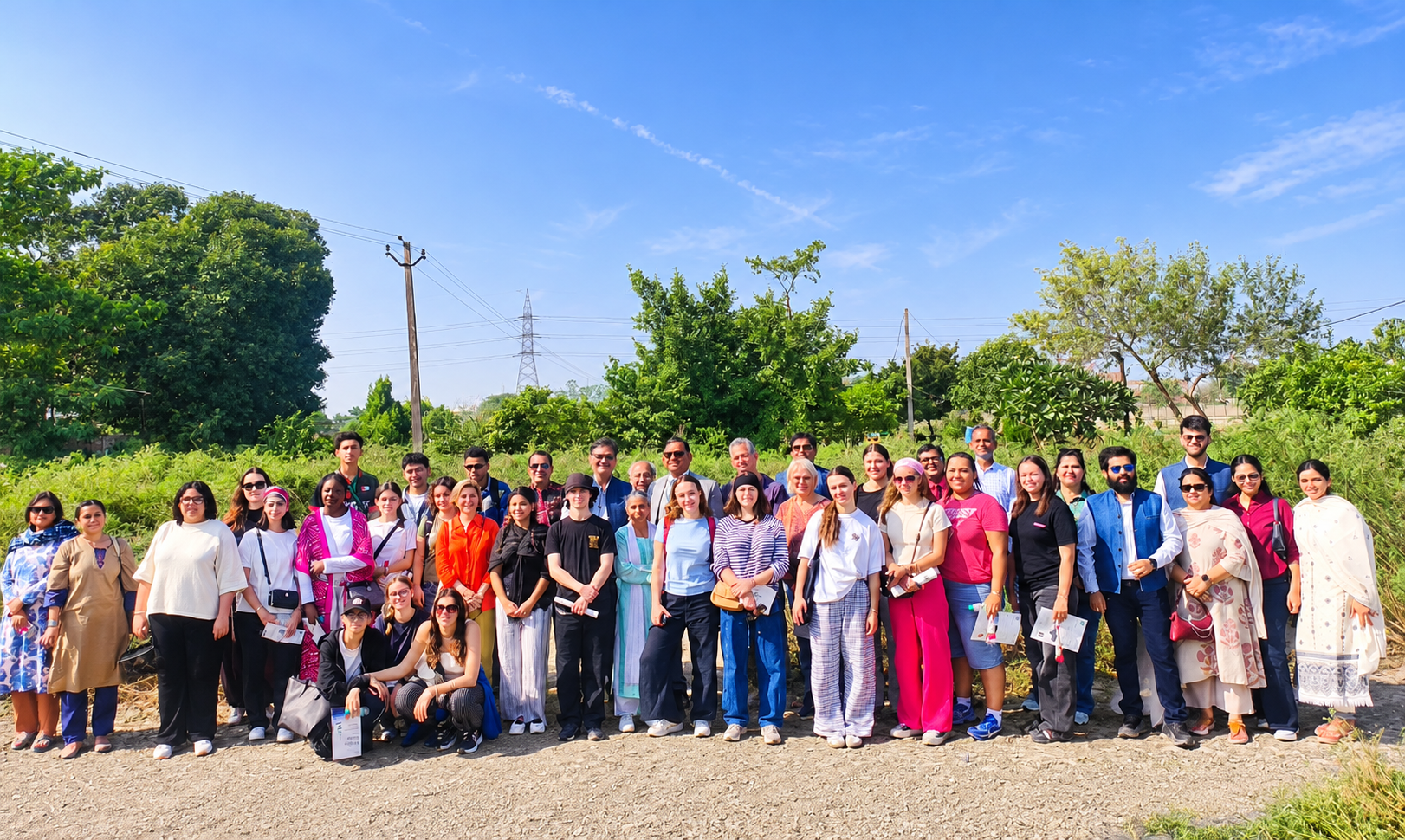
Two weaving cities, Lyon (France's silk capital) and Lucknow (the home of chikankari), reconnected today over a single thread. A blue one. On Saturday, a delegation of 22 students from LGT La Martinière Diderot in Lyon, France, led by Mrs Karine Skowronek, visited AMA Herbal Group's indigo fields at AMAzing Farm on Kursi Road. Facilitated by La Martinière College, Lucknow, as part of the Inter-Martinière Educational Meet, the visit was titled "The Blue Thread (Le fil bleu): Indigo Returns to the Fields of Awadh."
To honour the history that brought the students here, AMA Herbal welcomed the guests with Indian and French national flags printed using AMA's own natural dyes..
A Lyonnais who made Lucknow home
Claude Martin was born in Lyon in 1735, apprenticed in its silk workshops as a boy, and came to India as a soldier. From 1776 he lived in Lucknow as superintendent of the Nawab of Awadh's arsenal. He was also one of the early European names in Indian indigo, with factories at Najafgarh near Kanpur, at Pundri and at Korah, and the trade made him one of the richest Europeans in the country. He was curious about the craft, too. After watching Indian indigo being made at Ambore in the south, he wrote an account of the method, and it clearly impressed him.
His will split the estate between the places he held dearest. Seven La Martinière schools in Lyon, Lucknow and Kolkata now teach some 15,000 students, and those students travel between France and India on exchange visits all the time.
India's blue: rise, fall and return
India has dyed with indigo for over 4,000 years. The Greeks called it indikon, meaning from India. The later chapters were harder. Bengal's farmers rose up against forced indigo planting in the Nil Bidroho of 1859 to 1860. BASF began selling synthetic indigo in 1897, and by 1914 India's natural output had dropped to about 1,100 tonnes. Then, in 1917, Gandhi's Champaran Satyagraha in Bihar took on the indigo planters directly. In this country, nil was never only a colour. It is tied up with a farmers' revolt and with a freedom struggle that began in a field.
Ending the chemical impact
Synthetic dyes pushed natural indigo close to disappearing. AMA Herbal Laboratories was founded in Lucknow in 1996 by Dr. Yawer Ali Shah and Mr. Masood Ahmad Zaidi to bring natural dye extracts back to the textile industry, indigo among them. AMA introduced machine processing so natural indigo could be made consistently and at scale, and it removed the chemical burden that synthetic indigo carries. Its natural indigo passed trials on industrial rope dyeing machines between 2003 and 2005. In 2018 it became the world's first natural indigo textile dye with a full Life Cycle Assessment (LCA). AMA is now the largest exporter of natural indigo from India, supplying dye houses and fashion brands worldwide.
"Indigo is the king of colours, and it is the colour of denim," said Dr. Yawer Ali Shah, Co-Founder and CEO of AMA Herbal Group. "Its connection with La Martinière goes back to Claude Martin himself. Today that connection comes to AMA, as the leader in natural indigo. A team from Lyon has travelled to Lucknow to see an ancient art come alive again in Uttar Pradesh, and we are proud to show it to them."
Indigo comes home to Awadh
Natural indigo farming survived mostly in the south. AMA has spent the last five years bringing it back to Lucknow at AMAzing Farm, among the first such efforts in this part of India in over a century. The methods are modern and use 70% less water than usual, and AMA marked the progress with an indigo seminar on Kisan Diwas in 2022. Since day one the company has bought its partner farmers' harvests, supported them and shared know how. They now earn about twice as much per acre from indigo as from mint, and the next goal is to make it the new cash crop for farmers across Uttar Pradesh.
And the old saying that nothing will grow where indigo has grown? Not on these fields. Mustard has done well after indigo, and peppermint has grown right alongside it. Indigo is a legume, so it puts nitrogen back into the ground and leaves the soil richer for whatever comes next.
A Martinian affair
The visit came together through the school itself. Hamza Zaidi, VP - Sustainable Business Opportunities, along with Dr. Shah's son Aayan and daughter Aaeen, are all alumni of La Martinière College, Lucknow, and when the Lyon school's principal and staff heard the students wanted to see Claude Martin's old indigo business, they got in touch to ask about a farm visit.
"Claude Martin left us schools, but he also left us a story," said Mr Gary Dominic Everett - Principal of La Martiniere College, Lucknow. "To see our Lyon friends standing in an indigo field in Awadh, the very crop behind our founder's fortune, is something I will remember for a long time."
Hamza Zaidi of AMA Herbal said, "I grew up in the same school Claude Martin founded. Now I get to show students from Lyon what we are doing with the plant that built his fortune. It feels like closing a loop."
"Martinians always get pulled back to where it all began," said Aayan, who studied at La Martinière College. "It means a lot that the old indigo story is something we can show people again, with real fields and real farmers."
Leaf to blue
The students walked the fields and then followed the dye from plant to paste. Indigo is sown first, and being a legume it feeds the soil as it grows. The leafy stems are cut just before flowering, when the dye is at its richest and then the dye is extracted.
Certified, Standardised, Awarded
For Dr. Yawer Ali Shah, the work on natural dyes has been a nearly 30-year journey. AMA Herbal set up its own DSIR-recognised laboratory in Lucknow, when imported dyes still dominated India's market. Its natural dyes now find buyers in over 36 countries, including China.