The Crucial Role of the Healthcare Sector in Achieving the $1 Trillion Economy Target
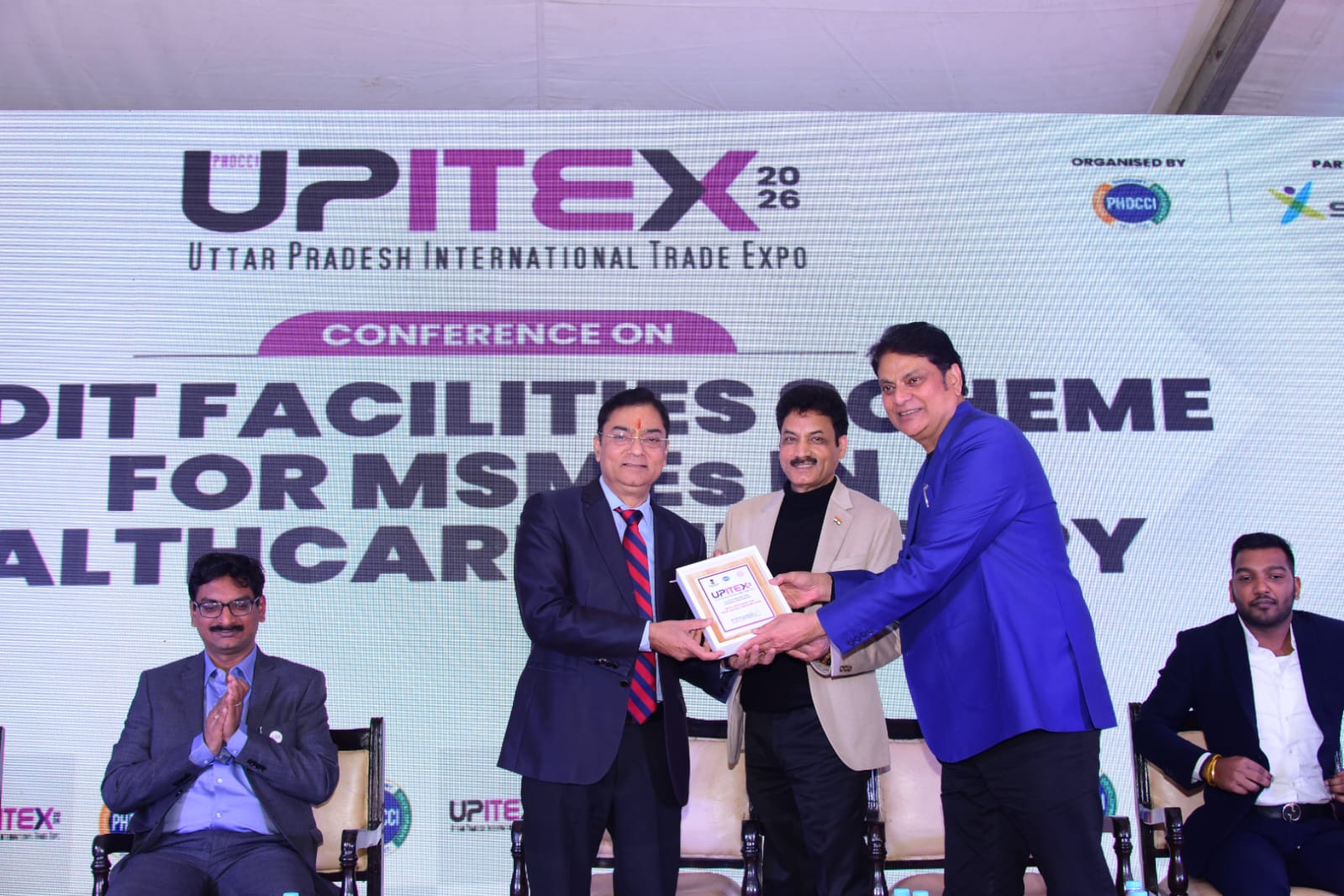
MSMEs are the backbone of India’s economy. Their role is even more significant in the healthcare industry, which includes enterprises such as hospitals, clinics, diagnostic centers, pharmaceutical companies, and medical equipment suppliers. These enterprises require capital for growth, but due to banking and financial challenges, access to credit often becomes difficult. Understanding this need, PHDCCI organized a conference on “Credit Facilities Scheme for MSMEs in Healthcare Industries” on the second day of the ongoing UPITEX event at Indira Gandhi Pratishthan.
The panel included Dr. Ranjeet Mehta, CEO and Secretary General, PHDCCI; Mr. Rajesh Nigam, Co-Chair, UP State Chapter, PHDCCI; Dr. Surya Kant, Professor and Head, Department of Respiratory Medicine, KGMU; Mr. Pranav Gupta, Director, GB System Equipment Pvt. Ltd.; Mr. Ashutosh Rai, Deputy Director, Bureau of Indian Standards; Mr. Jay Kumar Gupta, General Manager, SIDBI, Lucknow; Dr. Deepak Kumar Agrawal, Founder, Managing Director and President, Gastro Care Medical Research Foundation, Globe Healthcare; and Mr. Atul Srivastava, Senior Regional Director, UP State Chapter, PHDCCI.
Deepak Prajapati, who has been working in black clay pottery in Nizamabad for nearly 10 years, says that receiving the GI tag has increased his business by around 20%. He further shared that during the inauguration of the Purvanchal Expressway, a Ganesh clay pottery item was presented by Chief Minister Yogi Adityanath ji to Prime Minister Narendra Modi ji. Additionally, at the G7 Summit, a black pottery pot made by them was gifted by the Prime Minister to the Prime Minister of Japan. The biggest benefit of the GI tag has been that people can now identify and order authentic black clay pottery products. He said that their products are exported from England to China.
Mohammad Abid, a brassware trader from Moradabad, said that earlier this trade was dominated by big businessmen, but after Moradabad brass utensils received the GI tag, small traders like him have also been able to run their businesses with the support of NABARD.
During the conference, Dr. Surya Kant stated that Uttar Pradesh has shown outstanding performance under NITI Aayog’s Aspirational Development Blocks Programme. This is clearly evident as when he came to pursue his MBBS, there were only 8 medical colleges in the state, whereas today Uttar Pradesh has 80 medical colleges. The establishment of medical colleges forms the foundation of healthcare development. Similarly, till 2002 there was only one AIIMS in the country, while currently there are 33 AIIMS. In Uttar Pradesh, AIIMS are located in Rae Bareli and Gorakhpur, and the state also has three medical universities. Coincidentally, in 1905, when PHDCCI was established, the foundation stone of KGMU was also laid. Moreover, all major corporate hospitals are present in Uttar Pradesh. This has had a significant impact on health indicators—infant mortality rate in the state has reduced to just 38 per thousand, while maternal mortality has come down to 150 per lakh. Innovation plays the biggest role in the healthcare sector today. Robots have become a symbol of innovation in healthcare, and it is a matter of pride that all government hospitals are now equipped with robotic facilities.
Dr. Ranjeet Mehta, CEO & Secretary General, PHDCCI said that whenever social and economic welfare is discussed, healthcare facilities play a vital role. In achieving hon'ble Chief Minister Yogi Adityanath ji’s vision of a $1 trillion economy for Uttar Pradesh, the healthcare sector will make a major contribution. A healthy society ensures better productivity, because when children, mothers, and all sections of society are healthy, they can contribute more effectively. Along with this, the state’s digital and physical infrastructure plays a key role in driving growth. Uttar Pradesh is recognized as the “expressway state,” which is a major example of its infrastructure development. In terms of digital infrastructure, UPI is not only famous in India but across the world.
SIDBI General Manager Mr. Jay Kumar Gupta explained that SIDBI provides credit to MSMEs through both direct and indirect financing. Under direct financing, SIDBI lends directly to MSMEs, while under indirect financing, it provides refinancing to banks, NBFCs, and other institutions. In the healthcare sector, SIDBI manages government schemes for specific areas such as pharmaceuticals and also implements general MSME schemes applicable to hospitals, medical device manufacturing, and healthcare services. These schemes are designed to help MSMEs purchase equipment, manage working capital, upgrade technology, and receive support during difficult times. Especially during crises like COVID-19, special schemes were launched for the healthcare sector. At present, the entire world is looking at India not just as an opportunity, but as a solution provider.
Global Recognition with the Support of NABARD
GI-tagged products are a major attraction at UPITEX. Small entrepreneurs associated with these products are extremely happy. NABARD is playing an important role in exporting these products.
Rakesh Kumar, a shehnai maker and musician from Varanasi, says that the craft of making and playing the shehnai has been in his family since his grandfather’s time. He believes that his guru, Ustad Bismillah Khan, would have been immensely proud that the shehnai—whose magic he spread across the world—has now been honored with a GI tag. He adds that this tag has not only enhanced the dignity of shehnai artists but has also boosted their business. There was a time during the COVID period when this profession was almost finished, but due to government efforts, the shehnai has regained its prestige and respect. Now, orders are coming in from all corners of the country.